When I first moved to Switzerland, I remember a close German friend once excitedly telling me how she couldn’t wait to visit Lucerne for Fasnacht. She described a city completely transformed and taken over by people in elaborate costumes, loud brass bands (Guggenmusik), and what sounded like endless amounts of confetti – a total contrast to the stereotypical quiet and quaint image of the city.
As she talked, it dawned on me that Fasnacht was just another word for Carnival. Living in my Geneva bubble, I’d been completely oblivious to the fact that while our streets stayed quiet during this time of the year, massive celebrations were taking place just a train ride away. Turns out, there are dozens of Carnival and Fasnacht all around us. It’s like the one period of the year in Switzerland where everyone lets loose and being loud (*gasps*) in public is acceptable and encouraged.
While Carnival celebrations are mostly non-existent in Geneva today (thank you John Calvin), it is still a huge deal in Switzerland’s German-speaking cantons, across Europe, and around the world. In the 16th century, while cities like Catholic Lucerne kept their rowdy traditions alive, Geneva opted for more demure vibes. Masks, dancing, and street parties were banned to focus on a more ‘disciplined’ way of life. Though these days, to be fair, we essentially moved our street party to December for L’Escalade, which has become Geneva’s own unique way to let loose.
So, what is everyone else actually celebrating?
At its heart, Carnival is the ultimate “last hurrah.” Without going into a lengthy history lesson, it is essentially the final chance to eat, drink, and be merry before the forty days of Lent begins. It has evolved into a joyful burst of color during the long, grey days of winter, and I like to think it gives us all something to look forward to just as the post-holiday “back to work” slump of January sets in.
We’ve compiled the best Fasnacht and Carnival celebrations a day-trip away from Geneva and some noteworthy ones in Switzerland to consider for your 2026 calendar.
- Carnaval d’Evolène | 6 Jan – 17 Feb 2026
- Carnaval d’Onex | 31 Jan – 1 Feb 2026
- Lötschentaler Fasnacht | 3 – 17 Feb 2026
- Carnaval d’Estavayer-le-Lac | 6 – 8 Feb 2026
- Lucerne Fasnacht | 12 – 17 Feb 2026
- Carnaval de Monthey | 12 – 17 Feb 2026
- Carnaval des Bolzes | 13 – 17 Feb 2026
- Berner Fascacht | 19 – 21 Feb 2026
- Les Brandons de Payerne | 20 – 23 Feb 2026
- Basel Fasnacht | 23 – 25 Feb 2026
- Annecy Venetian Carnival | 27 Feb – 1 Mar 2026
🔥 Hot tip: While most Carnival celebrations are free to spectators, most cities will have Carnival badges (Plaketten in German or Médailles in French), which are the primary way these massive events are funded. While they aren’t technically “tickets”, it’s strongly encouraged to buy and wear them as a sign of respect. Some festivals do sell tickets for access to the grand procession, which we noted below.
🚸 For Parents with Little Ones: Most celebrations host a dedicated Children’s Carnival (e.g., Tuesday afternoon in Basel or Saturday in Sion), which features daylight parades, less ‘scary’ costumes and activities geared towards kids. It’s also important to take some noise-canceling earmuffs, as the Guggenmusik can be really loud.
1. Carnaval d’Evolène | Evolène | 6 Jan – 17 Feb 2026
For a completely unique carnival experience, look no further than Evolène. The celebrations are traditions deeply rooted in local pagan roots, featuring elaborate costumes, and notable “characters”. At the heart of the celebration is warding off evil spirits, and the unique figures of Evolène’s carnival (peluches, empaillés, maries, poutratze) help create a completely different experience that is authentic and at times eerie.
While the festivities have begun since the 6th of January, the 15-17 Feb would be the most exciting time to visit and see the ancient rituals. Sunday the 15th would be the best day to visit, as it features the “Wave of the Peluches and Empaillés”, where hundreds of these masked figures take over the whole village. Expect a lot of loud cowbells, and direct interaction with the Peluches and Empaillés, which involves a face rub of their hairy costumes that smell of raw, untanned skins, and being sprayed with water from the Empaillés.
2. Carnaval d’Onex | Onex | 31 Jan – 1 Feb 2026
The closest carnival celebrations to Geneva will actually take place in Onex, which is returning this year after a 20 year hiatus! The celebrations coincide with the 175th anniversary of Onex, so you can expect a massive celebration over 2 days, with 300+ musicians and a huge parade on Sunday. There will be costume contests, workshops for kids, and much more fun activities. This is a great opportunity for those that want the carnival experience without traveling outside of Geneva.
3. Lötschentaler Fasnacht | Lötschental Valley | 3 – 17 Feb 2026
Lötschental’s Fasnacht is widely considered the most haunting and atmospheric in Switzerland, thanks to the presence of the Tschäggättäs (the figures). The Tschäggättä are masked creatures that represent the ancient spirits of winter and the Lötschental valley. They roam the streets and scare people during the night while adorned with stunning hand made wooden masks, fur costumes, and very loud cowbells.
To see the Tschäggättä’s in action at night, they will walk (lurk?) through the villages in the Lotschental valley every evening (except Sundays) after work from 1-11 Feb. BUT if you want to see a large group of them, there is a night parade on Thursday the 12th, departing from Wiler at 9:15pm. The grand procession falls on Saturday, the 14th, also departing from Wiler at 2:30pm, where you can expect to see Tschäggättä, along with loud Guggenmusiken bands, and other processions.
4. Carnaval d’Estavayer-le-Lac | Estavayer-le-Lac | 6 – 8 Feb 2026
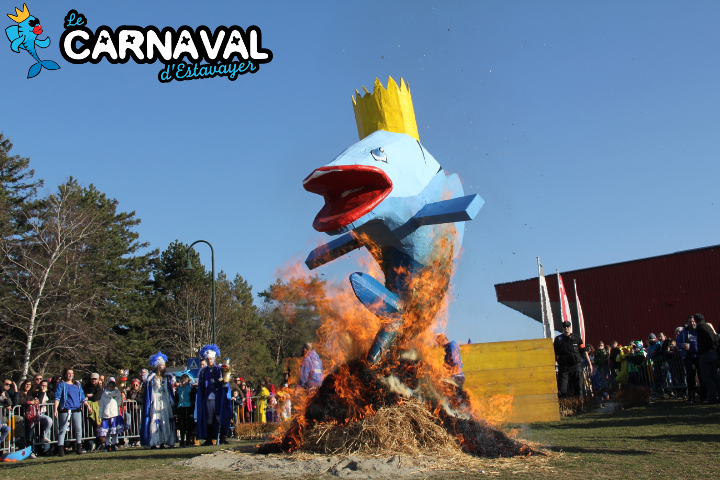
The Carnival celebrations at Estavayer-le-Lac lean into its medieval fishing town identity, featuring a huge papier-mâché Perch that is hung over the town to watch the celebrations and then burned on Sunday evening (au lieu of a “Snowman”) along with the grand procession. The town really transforms during this period of celebration, with family friendly events during the day and nonstop partying at night.
5. Lucerne Fasnacht | Lucerne Old Town | 12 – 17 Feb 2026
Lucerne’s Fasnacht celebrations is the city’s largest and most exciting event, drawing tens of thousands of people each year. It is a true vibe, and an unforgettable experience – celebrations often start in the early hours of the day, with large parades of elaborate floats and Guggenmusiken bands, and loads of dancing and drinking on the streets.
Celebrations last six days but it’s not running 100% the whole week, so if you’re visiting from out of town, it’s good to know which days the big events fall on:
- Dirty Thursday (Schmutziger Donnerstag) on the 12th is the grand opening day, with canons and confetti kickstarting the event at 5am, and a grand parade at 2pm.
- Similarly, Güdis Monday (Güdismäntig) on the 16th also starts with an early 5am wake up call, followed by a 2pm parade.
- The grand finale on the 17th, or Fat Tuesday (Güdiszischtig) is kind of the climax of the celebrations, with the children’s parade at 2pm and the nighttime “Monstercorso” massive, lantern-lit parade at 7pm.
There will still be celebrations outside of those days, just a bit quieter and on a smaller scale. Definitely check out the official program ahead of your trip.
Costumes are highly encouraged, even if it’s something as simple as a mask – you’ll feel left out if you don’t have one (speaking from personal experience). The SBB also has a special offer for travellers going to the Lucerne Fasnacht, which will be available starting from 24 January.
6. Carnaval de Monthey | Monthey | 12 – 17 Feb 2026
Monthey has one of the largest and oldest carnival celebrations in French-speaking Switzerland. The city essentially shuts down for 6 days of partying. You can expect to see Triboulets – jester-like figures in red and white who embody the spirit of the festival, which targets local and national politics with satire. The celebrations climax towards the end, with the grand procession taking place on Sunday the 15th, featuring over a dozen elaborate floats and Guggenmusik bands. The “Pimponicaille” (the 16th, Monday Night) is when the party really starts with people on the streets celebrating and bars that stay open until dawn.
7. Carnaval des Bolzes | Basse-Ville, Fribourg | 13 – 17 Feb 2026
Guggenmusik bands, hidden pop-up bars in medieval alleys, and the epic burning of Rababou in Fribourg’s old town (Basse-Ville or “lower town”) is another unique Carnival experience that is a short distance from Geneva. Rababou is a giant effigy that represents all the evils from the past year and ceremoniously burned in hopes of a fresh new start come spring. There is an evening procession on Saturday the 14th at 8:30pm, with lanterns lighting the way with the loud Guggenmusik bands, and of course the grand procession and burning of Rababou on Sunday the 15th at 2:39pm are the highlights that weekend. Admission for the grand procession is CHF 10.
8. Berner Fasnacht | Bern Old Town | 19 – 21 Feb 2026
Bern’s Carnival celebrations are the third-largest in Switzerland, and it’s considered more laid-back compared to Lucerne and the tradition is centered around the bear, the mascot of the city. Celebrations peak before Ash Wednesday and lasts only 3 days. There is a Children’s Carnival on the 20th, which is very family friendly, with tons of activities, music and food, and the grand parade that takes place all through the old town at 2:30pm on the 21st.
9. Brandons de Payerne | Payerne | 20 – 23 Feb 2026
The Brandons de Payerne is the largest and oldest carnival in the French-speaking side of Switzerland. Besides the expected parades, costumes, confetti and general merriment, what is unique about the Brandons de Payerne is the biting satirical nature of the celebrations. They publish a special carnival edition newspaper that famously mocks local politicians and figures, as well as the slightly controversial tradition of writing jokes and anecdotes on local shop windows. It’s a town-wide party, with the grand procession taking place on Sunday, the 22nd at 2pm. Access to Sunday’s grand procession costs CHF 13 for 16 year old+ and CHF 5 for 6-15 year olds.
10. Basel Fasnacht | Basel Old Town | 23 – 25 Feb 2026
The Carnival in Basel is the biggest in Switzerland and the only one Swiss Carnival festival listed as UNESCO Intangible Cultural Heritage, which gives you an idea of the scale and significance of the event. While it doesn’t fall on a weekend (boooo), it really is one of those events worth visiting some day if you live in Switzerland. There’s definitely some advance planning involved if you’re coming from Geneva.
The most famous event starts at 4am sharp on Monday (Morgestraich), where the city lights are switched off and the bands of musicians with drums and piccolos will start playing traditional marching tunes, accompanied by beautiful hand crafted lanterns.
The large parades fall on Monday and Wednesday afternoon from 1:30pm to 6pm, where you can expect the guggenmusik bands, elaborate floats and costumes, and tons of confetti. The lanterns are on display during this period at the Münsterplatz and really come to life at night.
11. Annecy Venetian Carnival | Annecy | 27 Feb – 1 Mar 2026
For a completely different Carnival experience than the ones we just talked about, we have Annecy’s Venetian Carnival. The “Venice of the Alps” really lives up to its name, as this event mirrors the aesthetic and vibes of the world famous Venice carnival. There’s no grand parade with loud music – quite the opposite, as the participants are dressed up in beautiful elaborate costumes and masks, and stroll around town in silence and anonymity. You can see hundreds of costumed figures wandering around Old Town, the medieval bridges, and the Jardins de l’Europe by the lake. There’s an evening stroll through town on Friday the 27th from 5:30pm to 8pm, and a day-time stroll from 2pm on Saturday the 28th, which is when you can expect to see the most costumes. The vibes are definitely more haunting and calm compared to the loud celebrations in Switzerland. It’s free for the public, and definitely worth a visit, considering it’s so close to Geneva.




Leave a reply to February 2026 Events: What to Do in Geneva & Beyond – Las Genevistas Cancel reply